Saturday, February 29, 2020

My King of Heaven


“Blessings on the King who comes in the name of the Lord!
 Peace in heaven, and glory in highest heaven!”
 (Luke 19:38 NLT)

“Be Thou My Vision” is a Christian hymn of Irish origin.  The words are based on a poem attributed to a sixth-century Irish poet and Priest, Saint Dallan Forgaill, who had gone blind.

One of the lines of the poem goes, “High King of Heaven, my victory won.
May I reach Heaven’s joys, O bright Heav’n sun” The powerful words of this song indicate that this Irish Priest, who could not see the world around him, saw God like most of us don’t.  He had a vision of heaven, like many of us, can’t grasp.

I will be seventy-four years old on my next birthday.  As I ponder about heaven, it seems sweeter with every succeeding year.  I don’t want to die, clinging to life is normal, yet when God calls my number, I don’t think I will argue.  As I have said before, you can be so heavenly minded that you are no earthly good, but you can also be so earthly minded you have no heavenly vision. 

Forgalill wrote, Thou and Thou only, first in my heart
                          High King Heaven, my Treasure Thou art.

I can only add, be Thou my vision, my Creator, and God.


Be Thou My Vision | Celtic Worship Debut Album 'Homeward' Available NOW: http://celticworship.co.uk


Friday, February 21, 2020

Grace Over Nature


But Joseph was upset when he saw that his father placed his right hand on Ephraim’s head. So Joseph lifted it to move it from Ephraim’s head to Manasseh’s head.  “No, my father,” he said. “This one is the firstborn. Put your right hand on his head.”
 (Genesis 48:17-18 NLT)

God's sovereign will does not always choose by order of nature.   God often picks the younger over, the older, and those seemingly less qualified over others.

Jacob and Esau
Manasseh was Joseph's oldest son.  The first-born always was the first to receive their inheritance.  In modern-day monarchies, the eldest son or daughter is first in line to the throne, not so with God.  Remember, Isaac was chosen before Ishmael, Jacob before Esau, Moses before Aaron, and David before his elder brothers.  God does not choose based on birth order, the education degrees we possess, or the affection that others' may place upon us.  He decides as he pleases.  That is why we call him God.

Joseph was upset because of Jacob, his Father, ignoring the rule of natural succession in his family.  Today, we get angry because someone is picked for leadership that may be less well-positioned, or seemingly less qualified than others.  We can be particularly distressed when that choice is someone else before us. 

One of the most freeing things I have ever learned is that I don't always have to be first.  God calls us through the grace bestowed upon us through our gifts and natural abilities. These gifts and talents are commensurate with our level of calling.  It is not about our age or position in an organization, but God's sovereign will.  God knows where we will be most effective and fulfilled.  Grace always prevails over nature.

Image used with permission by Microsoft.

Ken Barnes, the author of  “The Chicken Farm and Other Sacred Places”  YWAM Publishing
Email:  kenbarnes737@gmail.com
website:
Ken Barnes' Book Site
Blogs: http://kensblog757.blogspot.com
          
 http://gleanings757.blogspot.com


Thursday, February 13, 2020

Job-Humility and Repentance

Then Job replied to the Lord: “I know that you can do anything, and no one can stop you. You asked, ‘Who is this that questions my wisdom with such ignorance?’ It is I—and I was talking about things I knew nothing about, things far too wonderful for me. (Job 42:1-3 NLT)
 
People have read Job for centuries and have pondered about their suffering.  We can only understand our pain and anguish like Job did, through humility and repentance.

In Chapter 40, God asks Job a question. "Do you still want to argue with the Almighty?" Then Job answers contritely, "I am nothing---how could I ever find answers?"  I will put my hand over my mouth in silence." Sometimes we have to quit talking before we can hear from God.  Humility always precedes finding wisdom.  

God proceeds in this chapter and following to ask Job sixty-six questions, none of which he can answer.  Talk about bombing an exam.  The Lord was trying to say that he was God, and Job wasn't.  There is a great line in the movie "Rudy" by an old Catholic Priest, who said, "In thirty-five years of ministry there is one thing I have learned for sure.  There is a God, and I'm not him." Humility is just a proper view we are in relation to who God is.  Pride confuses the role of the creature and the Creator.

Suffering can make us bitter or better.  God never does explain to Job why he suffered.  Life is complicated, it is more than a cause and effect relationship. Job did not suffer because of his sin, nor was he blessed later due to his righteousness? Humility and repentance can make us look upon our blessings as a gift rather than an entitlement, which none of us deserve. 

The last thing that Job said to God was, "I had only heard about you before, but now I have seen you with my own eyes" (v.5).  Humility always opens our eyes to see who God is.

Image used with permission by Microsoft.

Ken Barnes, the author of  “The Chicken Farm and Other Sacred Places”  YWAM Publishing
Email:  kenbarnes737@gmail.com
website: 
Ken Barnes' Book Site
Blogs: http://kensblog757.blogspot.com
           
 http://gleanings757.blogspot.com

Monday, January 27, 2020

The Face of God


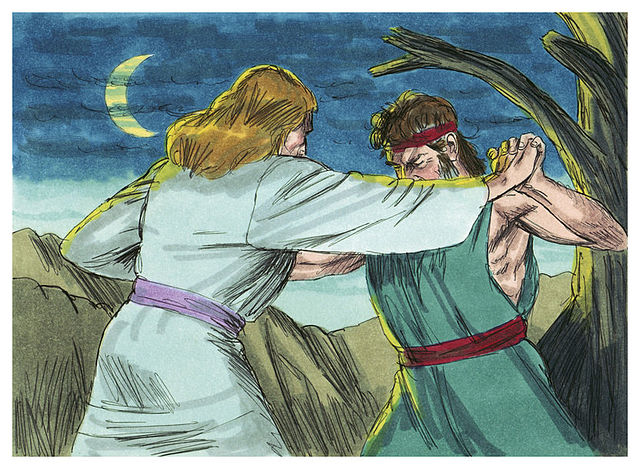
Jacob named the place Peniel (which means “face of God”), for he said, “I have seen God face to face, yet my life has been spared.” (Genesis 32:30 NLT)
Jacob Wrestling with God

Jacob came face to face with God, and he was finally changed by grace.

Jacob means the "supplanter" or the deceiver. His whole life, he had taken things that were rightly his in wrong ways. He acquired things through devious means rather than allowing God to give them to him. Jacob's selfishness has led him to a place where he was between a rock and a hard place. Esau, his brother, who he had swindled out of his inheritance, was bearing down on Jacob (Genesis32:6:7a NLT).  He is all alone, it is just Jacob and God; there is no one to manipulate (32: v.24). God often brings us to the end of ourselves, and then we see real change.

Jacob struggles all night with God, and as a reminder, God dislocated Jacob's hip. God knows we often forget. As the sun started to rise, Jacob knew that if he looked upon God face-to-face, he would die, yet he continues to struggle. Intuitively, he realized that life without God was not worth living. Consciously or unconsciously, he must have concluded; if I die, I must have God's blessing. If you must have God, you will.

The sun rose, and Jacob named the place Peniel "face of God." He had looked upon God, and the Lord spared his life. He finally understood grace. God changed his name from Jacob, the deceiver, to Israel, the one who prevailed with God. You cannot receive the grace of God without being transformed.

We, like Jacob, often miss God's grace because we try everything else first.

Image used with permission by Microsoft.

Ken Barnes, the author of  “The Chicken Farm and Other Sacred Places”  YWAM Publishing
Email:  kenbarnes737@gmail.com
website:
Ken Barnes' Book Site
Blogs: http://kensblog757.blogspot.com
          
 http://gleanings757.blogspot.com

Monday, January 20, 2020

The Value of Work


Next to them the Tekoites made repairs; but their nobles did not put their shoulders to the work of their Lord. (Nehemiah 3:5 NKJV)
 
When Nehemiah was building the wall around Jerusalem, a short statement is recorded, which should speak volumes to us about the value of work.

I once led a discipleship training school for a missionary training organization. On one occasion, we accepted a student from Nigeria who had been a spiritual leader in the church in that country. In his culture, he did not serve others; they served him.

We built a two-hour work duty into our daily schedule. When there was a prayer meeting or teaching session, our Nigerian student was one of the first to arrive. When it came to work-duties, he was difficult to find. One particular Saturday, we had a workday where I labored with the students on a dirty job.  Coming back from the work detail, the student from Africa, looked into my dusty face and said, “very practical Christianity.” He was finally starting to get it. Christianity is more readily caught than taught.

God rebukes the Tekoite nobles. The commentator Matthew Henry says that “they would not come under the discipline of being obliged to perform this service. They thought that the dignity and liberty of their rank exempted them from getting their hands dirty and serving God.”

The action of the Tekoites makes it evident that they believed that specific tasks had more value than others. Our work has value because God has called us to do it, and we are a person of value doing it. Satisfaction from a job well done is a separate issue from value.  We should not seek to get value from our work but to bring value to it.

The Tekoites were operating in the ways of the world, which says you have worth according to what you do. God does not see big or little people; he sees people. He majors on why we do what we do, not what we do. Whatever task God has called you to do, it has great value if you are doing it for him. Such will free us from the bondage of the Tekoite nobles, who looked to people rather than God for their acceptance.

It never devalues you to do what God has called you to do.

Ken Barnes, the author of  “The Chicken Farm and Other Sacred Places”  YWAM Publishing
Email:  kenbarnes737@gmail.com
website:
Ken Barnes' Book Site
Blogs: http://kensblog757.blogspot.com
          
 http://gleanings757.blogspot.com

Image used with permission by Microsoft.


Wednesday, January 8, 2020

Godly Sorrow


The Lord observed the extent of human wickedness on the earth, and he saw that everything they thought or imagined was consistently and totally evil. 6 So the Lord was sorry he had ever made them and put them on the earth. It broke his heart.
(Genesis 6:5-6 NLT)
 
These two Bible verses record a tragic statement. God was sad that he had put man on this earth, which broke his heart.

The Bible teaches that God is perfect and complete; he lacks nothing. He can exist without us, yet we see that he is broken-hearted over us. We can only understand this if we grasp the difference between humans and God’s sadness.

When we sin, we lose, the loss of relationship with God or with someone else, but we experience a loss. When we sin and reject God, he is sad, not because he has lost, remember God is totally self-sufficient. He experiences sorrow because God knows we have lost. His love is others-oriented.

Worldly sorrow, being sad when we sin because of what it does to us, does not lead to repentance. Think about Judas as an example. Godly sorrow is the type of sadness over the grief it causes to the heart of a good and kind God; or to others who may not be so good. Only this kind of sorrow leads to true repentance.

You and I are the offspring of Adam and Eve, and we have inherited their self-centeredness. No, we can never be totally God-like, but we can reflect his image. The first step may be admitting our self-righteousness or any other character trait that starts with self. Godly sorrow and selfishness do not coexist. To have one, you must give up the other.

Image used with permission by Microsoft.

Ken Barnes, the author of  “The Chicken Farm and Other Sacred Places”  YWAM Publishing
Email:  kenbarnes737@gmail.com
website:
Ken Barnes' Book Site
Blogs: http://kensblog757.blogspot.com


Wednesday, January 1, 2020

Working and Waiting


But you must not forget this one thing, dear friends: A day is like a thousand years to the Lord, and a thousand years is like a day. (2 Peter 3:8 NLT)

It was during the 1970s when a book called "The Late Great Planet Earth" by Hal Lindsay was popular. We all expected Lord's return in the next forty years. We were mistaken, but we were only half wrong.

We always miss it when we either over or under emphasize a Biblical truth. James 5:8 (NLT) says that "You, too, must be patient. Take courage, for the coming of the Lord, is near", yet, in the scriptural passage above, a day maybe like a thousand years and vice versa. The Bible often gives seemingly contradictory teaching intended to balance our actions. Leaning too far in one direction or the other on the pendulum of working and waiting can distort Biblical truth.

We have all heard the expression; he is so heavenly minded; he is no earthly good — this idiom comes when we exercise waiting at the expense of working. Laboring without any expectation of Christ's imminent return will make us so earthly-minded that we have no heavenly vision. In nature, opposites attract each other. It is also true in the spiritual world. When we work here on earth, it creates a desire to be with him in heaven.

Conversely, when we desire to be with him, it motivates us to work here on earth. They work with each other, not against each other. It is never much fun in a playground if one end of a seesaw is always up or down.

In 2020 let's work and wait so that God's will be done on earth as it is in heaven. 

Image used with permission by Microsoft.

Ken Barnes, the author of  “The Chicken Farm and Other Sacred Places”  YWAM Publishing
Email:  kenbarnes737@gmail.com
website:
 Ken Barnes' Book Site
Blogs: http://kensblog757.blogspot.com
          
 http://gleanings757.blogspot.com